
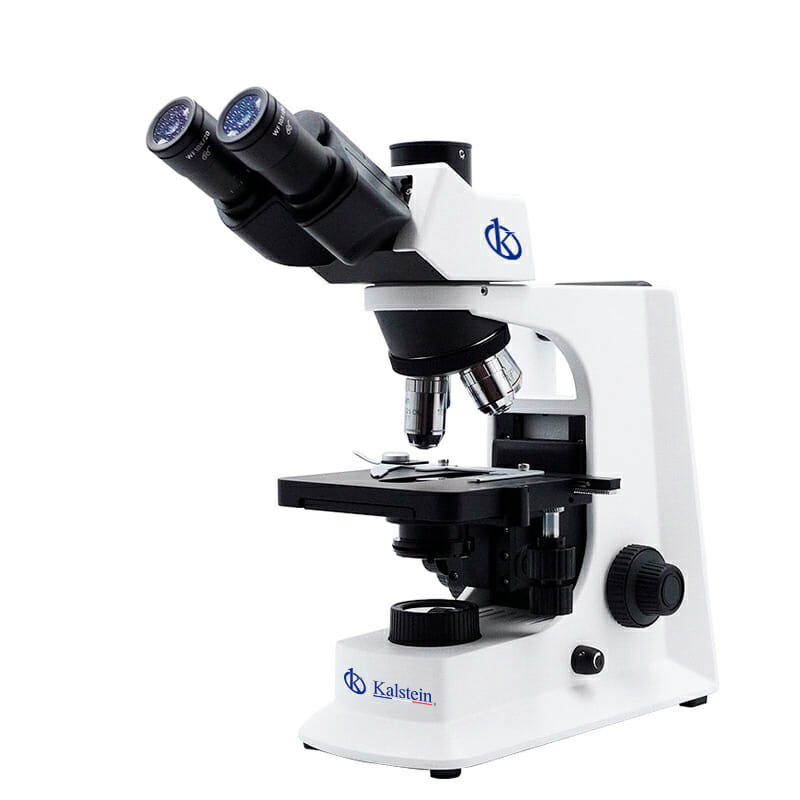
The Laboratory Biological Microscope, Trinocular, Achromatic YR05788-AT by Kalstein stands as a milestone in precision and functionality for laboratory settings. This sophisticated equipment features a trinocular head with an achromatic lens system that ensures a crisp and sharp image quality vital in biological exploration. It’s engineered to deliver consistent performance with advanced magnification capabilities, and its ergonomic design facilitates seamless use during extensive medical or biological studies. Users benefit from an intuitive control system, making adjustments simple without compromising on the detailed observation required in clinical settings.
On the other hand, we have the BXL-3A Trinocular Biological Microscope from AmScope. Known for its reliability, this microscope offers a trinocular head and practical design with adequate magnification options suited for educational and routine laboratory applications. While it shares similar base functionality with the Kalstein model, its build is more suited to straightforward tasks rather than high-intensity professional or research environments. Nevertheless, it rounds out as a robust piece of equipment well-regarded for its cost-effectiveness and dependability, appealing primarily to education institutions and beginner laboratories.
| Feature | Kalstein YR05788-AT | AmScope BXL-3A |
|---|---|---|
| Head Type | Trinocular | Trinocular |
| Lens System | Achromatic | Standard |
| Application | Advanced Research | Education/Basic Research |
| Image Quality | High-definition | Standard Resolution |
| Price Range | Mid-High | Low-Mid |
How They Work
Both microscopes work by directing light through the optical system to achieve magnification. The Kalstein model uses an achromatic lens system reducing distortion and providing an enhanced image quality ideal for detailed biological analysis. Its design focuses on maintaining stability and accuracy, crucial for sensitive clinical work. The AmScope BXL-3A, while also employing a trinocular setup, uses standard lenses, meaning that while it achieves necessary magnification for routine lab work, the image clarity isn’t as refined as the Kalstein model, but it’s perfect for basic educational purposes.
Purpose
Trinocular biological microscopes like Kalstein’s YR05788-AT are designed for advanced scientific research, allowing professionals to capture images directly through digital cameras mounted on the third ocular port. This makes them indispensable in environments where documentation and detailed analysis are crucial. Meanwhile, the AmScope model serves well in teaching scenarios, providing students with access to adequately powered microscopes to perform biological observations and learn through practical engagement.
Types
While both models are trinocular microscopes, the Kalstein YR05788-AT falls under the category of research-grade equipment – focused on delivering precise scientific insight. The AmScope BXL-3A suits the category of educational microscopes, which are simplified versions used primarily for learning and basic investigations.
Market Price
In the marketplace, the Kalstein YR05788-AT positions itself within a mid-to-high price range, reflecting its advanced features and suitability for complex laboratory work. The AmScope BXL-3A, however, is more budget-friendly, appealing to educational institutions and small-scale labs that require simple but reliable microscopes. Overall, prices can vary significantly depending on additional features and regional market dynamics.
Frequently Asked Questions
What is the primary use of a trinocular microscope?
Trinocular microscopes are specifically designed to allow a third ocular for camera integration to capture images, making them ideal for documentation and advanced studies.
Are achromatic lenses necessary for all laboratory work?
Achromatic lenses significantly reduce color aberrations, offering clearer images, which is critical in fine-detail work. However, for basic educational purposes, standard lenses may suffice.
Advantages and Disadvantages
The Kalstein YR05788-AT brings numerous advantages like high-definition imaging, ergonomic design, and suitable applications for advanced research, though it comes at a higher price. On the other hand, the AmScope BXL-3A is competitively priced and great for educational purposes but lacks the high-end features required in specialized research.
Use in the Field
Kalstein’s model is engineered for use in research facilities where precision and image clarity are crucial, contributing significantly to clinical diagnostics and biology studies. The AmScope BXL-3A, however, finds its place in educational settings, aiding in teaching by providing hands-on observational experience.
Recommendations
For those investing in a trinocular microscope, it’s recommended to consider your specific use case: laboratories requiring high precision should opt for Kalstein’s offering, while those at educational institutions might find the AmScope model more suitable and economically viable. Regular maintenance and calibrations are important for both to ensure longevity and consistent performance.
If you’re looking for a fusion of innovation and quality, you’ve come to the right place. At Kalstein, we offer you the luxury of exploring our exclusive catalog of laboratory equipment. We manufacture each piece with a level of excellence. Our intuitive and agile online purchasing channels are designed for your convenience, ensuring the most friendly prices. Don’t hesitate any longer, we bring science to life, it’s time to become part of our community. https://kalstein.it/product/laboratory-biological-microscope-trinocular-achromatic-yr05788-at/.